Torque & drive
- Unstable
- Solid pistons, friction, single-axis motion
- FDDS
- A fluid piston shaped by fields, moving on any axis
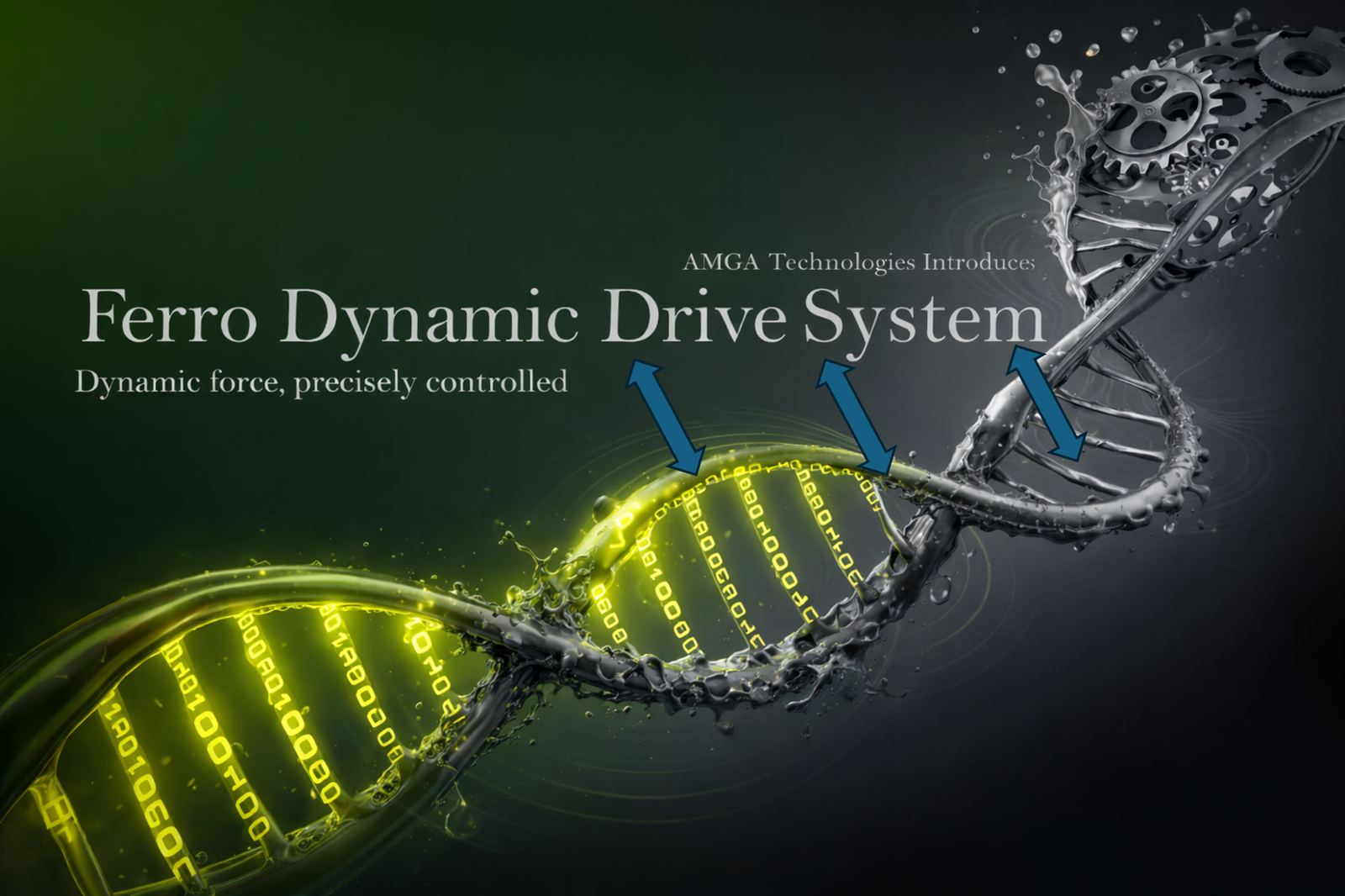
Take a flow that won't hold still, and give it a shape that does work.
Ferrofluid is oil full of iron particles too small to see. Left alone it drifts like any liquid. Put a magnetic field across it and it lines up, holds a shape, and pushes. FDDS starts from that one behavior.
"What if the piston weren't solid?"
An engine wears out where metal rubs metal: pistons, rings, bearings, seals. FDDS swaps the solid piston for a body of ferrofluid held inside a chamber of magnetic coils. The coils shape the fluid into a piston, move it, split it into two, merge it back, or send it down a branch to drive a second shaft.
A conventional engine can stay in the system as the refinery. It makes the energy, and the magnetic chamber turns it into motion with very little left to wear.
Every piece of it sits inside known physics: classical electromagnetism, thermodynamics and ferrofluid dynamics. Nothing in it needs a new law.
The drive is where it started. The idea underneath it is broader: find the flow that's working against you, then shape it instead of fighting it. These are the places AMGA is applying it.
A magnetically directed ferrofluid actuator that produces linear, multi-axis and branched motion without mechanical pistons or rotating joints. Ferrofluid masses are shaped, split and propelled by dynamic magnetic field gradients inside a semi-rigid chamber, for robotics, low-power propulsion and hybrid engine–magnetic systems.